
Most ecommerce stores send order updates by email and hope someone opens them. WhatsApp messages get read in minutes, not days, and that gap changes how carts get recovered and how buyers track shipments. If your current stack treats chat as a side channel, you are paying for messages nobody sees.
This article covers what the WhatsApp Business API actually does for online stores, from order confirmations and abandoned cart flows to native payments and catalog sharing. You will learn the real setup and Meta verification process, which templates get approved or blocked, where ROI shows up and where it does not, and how a unified platform like Com.bot fits alongside automation and multi-channel support.
Why WhatsApp Outperforms Email and SMS for Ecommerce
Ecommerce marketers have long relied on email and SMS, but WhatsApp consistently delivers higher engagement because it operates where customers already spend their time. The channel feels personal rather than promotional, which changes how people respond to it.
Email inboxes are crowded and filtered. SMS is immediate but limited to plain text. WhatsApp sits in between: it is conversational, visual, and instant, so messages read like a chat with a friend rather than a broadcast.
That conversational nature also supports two-way messaging. Shoppers can reply, ask questions, and confirm details without leaving the app, which keeps the buying journey moving instead of stalling.
For ecommerce stores, the result is a channel that feels less like marketing and more like service. The next section breaks down how that difference shows up in open rates, clicks, and purchases.
Open Rates, Click-Throughs, and Purchase Behavior Compared
When you compare the numbers side by side, WhatsApp's open rates tend to exceed email and SMS. These industry benchmarks vary by audience and list quality, but the gap is consistent across most reports.
Click-through rates follow a similar pattern. WhatsApp messages commonly see higher click-through rates than email. The difference comes down to context: a message that arrives inside a chat app invites a tap, while a promotional email competes with dozens of others.
Purchase behavior reflects the same trend. Stores using WhatsApp for cart recovery and follow-ups often report stronger conversion rates than email or SMS alone, with cart recovery tending to improve after switching.
Three psychological factors explain the gap:
- Immediacy: messages appear in real time and are typically opened within minutes, not hours or days.
- Trust: WhatsApp feels like a personal channel, so shoppers treat messages as relevant rather than intrusive.
- Rich media: product images, catalogs, and interactive buttons let customers act without leaving the conversation.
These traits make WhatsApp especially effective for abandoned cart reminders, order updates, and product questions, where timing and clarity directly influence whether a shopper completes a purchase.
What the WhatsApp Business API Actually Enables (Beyond the App)
The WhatsApp Business API unlocks capabilities that the free app cannot match, from programmatic messaging to deep integration with your ecommerce stack.
Where the consumer app suits a single operator sending manual replies, the API is built for scale. It supports two-way messaging across multiple agents, automated flows, and connections to your CRM, helpdesk, and order systems.
Businesses access it through the WhatsApp Business Platform, either via the Cloud API or an on-premises API, usually working with a Business Solution Provider (BSP). A verified WhatsApp Business Account (WABA) links to Meta Business Manager, and a permanent access token plus webhook endpoints keep data flowing.
This foundation is what makes the use cases below possible.
Order Confirmations, Shipping Updates, and Abandoned Cart Recovery
Transactional messages like order confirmations and shipping updates are well suited to time-sensitive ecommerce communications.
Order confirmations use message templates with dynamic fields such as order number, item name, and total. Because these are business-initiated messages, they require template approval before sending.
Shipping updates work best when triggered by carrier webhooks. When the courier posts a status change to your API endpoint, your system fires the matching template automatically.
Abandoned cart recovery follows a sequence. Experts recommend reminders after abandonment, each with a personalized offer. Personalization lifts response, so reference the exact product left behind.
All three fall under the utility category, which keeps them compliant and cost-efficient when the content stays transactional. Note that customers must opt in first, and every message should include a clear opt-out path.
Native Payments and Catalog Sharing Inside the Chat
WhatsApp now supports native payments in several markets, allowing customers to complete purchases without leaving the chat.
You start by uploading a product catalog to your WABA, then connecting a payment gateway. Supported methods vary by country, for example credit cards in many regions and UPI in India. Availability depends on your market and payment provider.
Once live, interactive buttons, quick replies, and list messages let shoppers browse items, add to cart, and pay in a few taps.
Setup follows a clear path:
- Connect a supported payment gateway to your WhatsApp Business Account.
- Upload catalog items with images, prices, and descriptions.
- Use interactive messages to guide customers toward checkout.
Keeping payment in-chat removes the redirect to a browser, which reduces friction and helps lower cart abandonment. Customers stay in one place from browsing to confirmation.
The Real Setup Requirements and Approval Process
Getting started with the WhatsApp Business API involves more than just downloading an app. It requires careful preparation to meet Meta's requirements.
Unlike the consumer WhatsApp app, the WhatsApp Business API is an enterprise-grade product. It connects to the WhatsApp Business Platform and gives ecommerce stores the ability to send business-initiated messages, receive customer-initiated conversations, and automate support at scale.
Before any of that becomes possible, three prerequisites must be in place:
- A verified Meta Business Manager account. This is the umbrella under which your WhatsApp Business Account (WABA) will live.
- A dedicated phone number. It cannot be tied to an existing personal or standard WhatsApp account.
- A display name that complies with Meta's policies. The name must clearly reflect your brand and cannot be generic or misleading.
Most stores also choose a Business Solution Provider (BSP) or connect directly through the Cloud API. The Cloud API removes the need to host infrastructure, while the on-premises API gives larger teams more control at the cost of greater maintenance overhead.
Each choice affects setup time, cost, and how quickly you can launch conversational commerce. Getting the prerequisites right the first time avoids repeated submissions and delays.
Meta Verification, Phone Numbers, and Common Rejection Reasons
Meta rejects a share of initial business verification submissions due to mismatched business details or unclear phone number ownership. That makes accuracy the single most important part of the process.
Here is the typical sequence for verifying a business inside Meta Business Manager:
- Log into Meta Business Manager and open Business Settings.
- Navigate to the Security Center and select Start Verification.
- Confirm your legal business name, address, and phone number exactly as they appear on official records.
- Upload supporting documents, such as a business license, utility bill, or tax registration.
- Wait for Meta's review, which can take several business days.
For the phone number, Meta accepts landlines, mobile numbers, and certain VoIP lines, provided you can receive an SMS or voice call for verification. The number cannot already be registered to a personal WhatsApp account. If it is, you must delete that account first or choose a different line.
Display name rejections are also common. Keep these rules in mind:
- The name should match your brand or legal entity.
- Avoid generic terms like "Support" or "Sales" on their own.
- Do not include URLs, slogans, or special characters.
After verification, you will generate a permanent access token, configure your webhook, and connect your API endpoint. From there, you can register message templates for approval and begin handling session messages inside the 24-hour customer service window.
Two operational details deserve early attention. First, build opt-in and opt-out handling into your checkout and account flows before you send a single business-initiated message. Second, track message delivery status and read receipts so you can measure whether your templates and quick replies actually perform.
Stores that prepare documents carefully and choose a clean phone number usually move through approval without friction. Those that rush tend to resubmit multiple times, which pushes back every downstream step.
Template Messages: What Gets Approved and What Gets Blocked
Template messages are pre-approved formats for business-initiated conversations, and getting them right is crucial for uninterrupted communication. On the WhatsApp Business API, every message a store sends outside the 24-hour customer service window must use an approved template.
Meta reviews each submission against its commerce and messaging policies before it can go live. Templates that break those rules get rejected, which stalls order updates and promotions until the wording is fixed. There are three template categories, each with its own approval bar.
Marketing vs. Utility vs. Authentication Templates
Marketing templates promote offers and are subject to stricter review, while utility templates facilitate specific transactions and authentication templates verify user identities. Choosing the right category matters, because sending a promotional message as utility can trigger rejection or account penalties.
Each category serves a distinct purpose in an ecommerce store's messaging flow:
- Marketing: Announcements like "Get 20% off your next order" or a back-in-stock alert. These require clear opt-out instructions and often see longer review times.
- Utility: Transaction updates such as "Your order #123 has shipped" or a delivery confirmation. Keep these purely informational.
- Authentication: One-time codes like "Your verification code is 123456" for login or checkout verification.
The most common rejection cause is promotional language inside a utility template. Adding "Shop now" or a discount mention to an order update pushes it into marketing territory, where it needs opt-out language and faces stricter scrutiny.
To improve approval odds, use variables for personalization, such as a customer name or order number, and keep formatting clean. Marketing templates should always include a clear way for recipients to opt out. If a template is rejected, stores can edit and resubmit it, or file an appeal through Meta Business Manager when the decision seems incorrect.
Where Ecommerce Stores See Actual ROI - and Where They Don't
While many ecommerce stores achieve strong ROI on WhatsApp campaigns, success depends on understanding conversation-based pricing and avoiding low-value use cases.
WhatsApp Business API returns vary widely by use case. Stores that focus on high-intent customer interactions typically see stronger returns than those chasing broad promotional blasts.
The difference comes down to two factors: which conversation categories you trigger, and whether your messaging solves a real customer need at the right moment. A cart recovery message sent hours after abandonment performs differently than a generic weekend sale broadcast.
Understanding where returns concentrate, and where they stall, helps ecommerce teams allocate budget toward interactions that actually convert.
Costs, Conversation Categories, and No-Markup Billing Explained
WhatsApp charges per 24-hour conversation, with rates varying by category: marketing, utility, authentication, and service. Each category carries different pricing because each serves a distinct purpose in the customer journey.
Approximate per-conversation rates vary by country and currency, but typical ranges look like this:
| Category | Approximate Cost | Typical Use |
|---|---|---|
| Marketing | $0.05 - $0.10 | Promotions, cart recovery, re-engagement |
| Utility | $0.02 - $0.05 | Order confirmations, shipping updates |
| Authentication | $0.01 - $0.03 | One-time passwords, login verification |
| Service | Free | Customer-initiated support within the 24-hour window |
Service conversations cost nothing because the customer starts them. When a shopper messages your store with a question, the reply falls inside the 24-hour customer service window and avoids marketing charges entirely.
Business Solution Providers (BSPs) often add a markup on top of Meta's base rates. Some platforms now offer no-markup billing, passing through Meta's pricing directly. This matters for stores sending high volumes, where even a small per-conversation markup adds up quickly.
To calculate ROI, use this formula:
- ROI = (Revenue from WhatsApp - Total WhatsApp Costs) / Total WhatsApp Costs
- Revenue includes direct conversions plus assisted conversions traced to message links
- Costs include per-conversation fees, BSP markup, and any platform subscription
Use case performance varies significantly. Abandoned cart recovery typically delivers the highest returns because the shopper already showed purchase intent. Order updates sit in the middle, reducing support tickets and improving satisfaction without directly driving sales. Mass marketing to cold audiences produces variable results and often the weakest returns per dollar spent.
Stores that prioritize opted-in, high-intent interactions see the strongest ROI. Those that treat WhatsApp like a bulk SMS channel usually see costs rise faster than revenue.
Choosing a Platform: Build vs. Buy vs. Unified Inbox
Ecommerce stores face a critical decision: build a custom WhatsApp integration, use a BSP, or adopt a unified inbox platform that also handles other channels. Each path carries different tradeoffs in cost, speed, and long-term flexibility.
Building in-house means connecting directly to the Cloud API or on-premises API, managing your WhatsApp Business Account, handling phone number verification, and maintaining webhooks yourself. You get full control over data and logic, but the engineering effort is significant and ongoing.
Buying through a Business Solution Provider speeds up launch. A BSP handles the Meta requirements and gives you a working API endpoint quickly. The catch is that many BSPs focus narrowly on WhatsApp, so other channels like Instagram or Facebook remain separate tools.
A unified inbox combines WhatsApp with other messaging channels in one place and often bundles automation. For stores juggling multiple touchpoints, this reduces tool sprawl and keeps conversations in a single view.
- Build: highest control, highest cost and maintenance
- BSP: faster setup, but may lack multi-channel features
- Unified inbox: multi-channel coverage, often with automation included
The right choice depends on your volume, team size, and how many channels you plan to support. The sections below break down how one unified platform, Com.bot, approaches these questions.
How Com.bot Handles WhatsApp API, Automation, and Multi-Channel Support
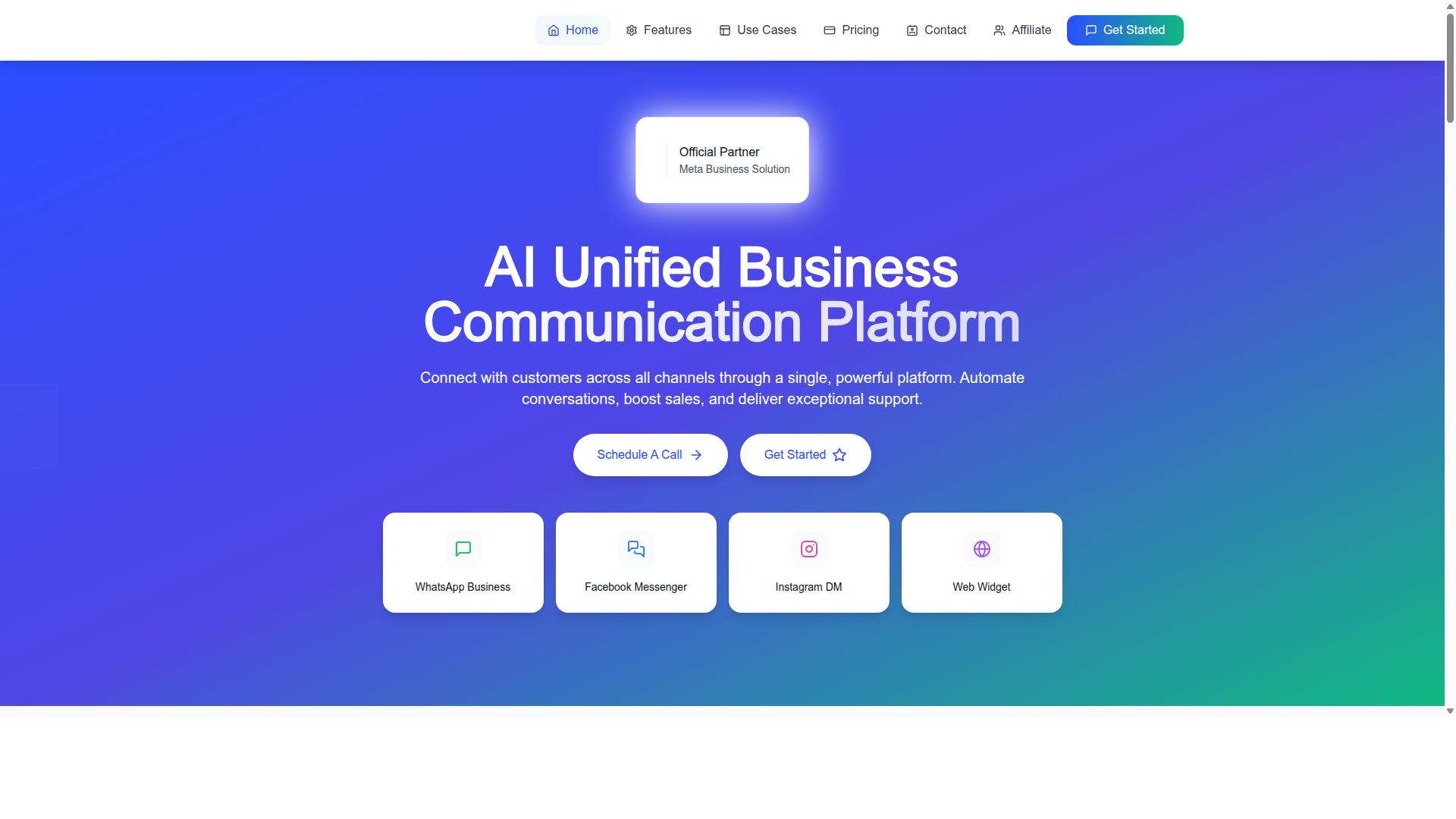
Com.bot provides an AI-powered unified business communication platform that connects WhatsApp, Facebook Messenger, Instagram DM, and web widget into a single inbox. That means customer-initiated conversations and business-initiated messages flow through one place instead of scattered tools.
The platform is built on official WhatsApp Business API integration, and Com.bot operates as an official Meta Business Partner. It processes 25M+ messages per day, a scale that matters for stores handling order updates, support, and payment collection at volume.
For automation, Com.bot offers a visual Bot Builder with a drag-and-drop interface. An Automation Builder connects to 1000+ integrations, so order updates and notifications can tie into existing systems.
Other capabilities relevant to ecommerce include:
- Native Payments for completing WhatsApp transactions
- Bulk Messaging for notifications and order updates
- Team Collaboration with role-based access
- External Integration for connecting outside tools
Together, these features simplify conversational commerce. Instead of stitching together a BSP, a chatbot tool, and a shared inbox, stores get automation, messaging, and multi-channel support in one platform.
Com.bot Pricing Tiers and Add-Ons for Growing Stores
Com.bot offers three quarterly plans: Silver at $149, Gold at $349 (recommended), and Platinum V1 at $2500. Pricing is listed in USD, with WhatsApp messaging billed at actual Meta rates and no markup.
Silver suits small stores testing conversational commerce for the first time. Gold, the recommended tier, targets growing businesses that need more capacity across channels and automation. Platinum V1 serves enterprises with larger teams and heavier messaging volumes.
Add-ons let stores scale without jumping tiers. Each costs $10 per month and covers options like an additional team member, a social channel, external actions (per 5000), bot triggers (per 25000), or an ecom store.
| Plan | Price (per quarter) | Best For |
|---|---|---|
| Silver | $149 | Small stores |
| Gold | $349 (recommended) | Growing businesses |
| Platinum V1 | $2500 | Enterprises |
Dedicated support is available separately: WABA, CRM, and Inbox support at $49 per hour, and Ecommerce, Bots, and Automations support at $99 per hour. For stores scaling their communication, the modular add-ons mean you pay for capacity as you grow rather than overbuying upfront.
Common Mistakes That Get Numbers Banned
Sending messages without proper opt-in or violating template guidelines can get your WhatsApp number banned. Meta enforces quality standards strictly, and ecommerce stores that treat the WhatsApp Business API like a bulk SMS tool often lose access before they see any return.
The good news is that most bans trace back to a handful of avoidable errors. Fixing them protects your WhatsApp Business Account and keeps conversational commerce running.
Sending promotional messages without opt-in. Business-initiated messages require clear, documented consent. Buying a phone list or importing customer emails without asking permission is the fastest route to high block rates and a restricted number.
Using misleading or mismatched templates. If a message template promises an order update but delivers a promotion, recipients report it. Meta reviews template approval against actual usage, and repeated mismatches damage your quality rating.
Ignoring the 24-hour customer service window. Once a customer messages you, you have 24 hours to reply with free-form session messages. After that window closes, you must use an approved template. Stores that keep sending session-style replies outside the window trigger delivery failures and complaints.
Letting block and report rates climb. Meta tracks how often users block or report your number. A rising rate signals spammy behavior, and sustained high rates lead to temporary or permanent bans.
Solutions start with record keeping. Maintain timestamped proof of opt-in for every contact, including where and when consent was given. Segment audiences so promotions reach engaged buyers, not your entire database. Monitor your quality rating inside Meta Business Manager weekly, and pause campaigns the moment it drops.
Finally, review Meta's commerce and messaging policies on a regular schedule. Rules around template categories and opt-in expectations change, and staying current is the simplest protection for your WABA.
Recommended Resources: